“We kept those subs working. We kept those sailors fed. We gave them what they needed to do their jobs.” DP2 Virgil Hollender
The United States Navy Memorial Stories of Service Program is honored to announce the December 2025 story of the month has been selected to recognize the service of United States Navy Veteran, DP2 Virgil Hollender. The United States Navy Memorial Stories of Service Program is privileged to interview DP2 Virgil Hollender at the Westlake Veterans Club in the Summer of 2024.
In the turbulent years of the Vietnam War, when the nation was divided and the draft loomed large, Virgil Hollender made a decision rooted in tradition and quiet courage. A young man with a borderline draft number and a strong sense of duty, he chose to serve—not for glory, but because it was the right thing to do.
“I always grew up believing that earlier generations served,” Hollender said. “My father served. Grandpa Mickey was a World War I veteran. So I took it as my duty to serve.” Though unsure about becoming an infantryman in Vietnam, Hollender explored his options. The Navy, recognizing his early experience in computers, offered him a path that aligned with his skills. “They said if I provided certain information, I’d probably be designated for computers. No guarantees. But I got them the information, and I went in designated.”
Boot camp at Great Lakes was a whirlwind of training—firefighting, knot-tying, marching, and gas chamber drills. “They made you take off your gas mask and stand there. It was terrible. I remember thinking, ‘I will never complain about a fart again in my life.’ And I haven’t.” Despite the challenges, camaraderie flourished. His company won the intelligence award for their battalion. “We just barely qualified at marching—we had two left feet—but we won the intelligence.”
Assigned to Commander Service Forces Atlantic Fleet, Hollender worked in early Navy computing—handling punch cards and data listings. One day, while delivering supplies to a nearby carrier, he found himself sipping coffee with the crew when the call came: “Shift colors.” The ship was getting underway.
“I probably turned white as a ghost,” he said. “I thought I’d have to get off with the harbor pilot, face the CO… I was in so much trouble.” But it was all a prank. The ship simply moved to the other side of the pier.
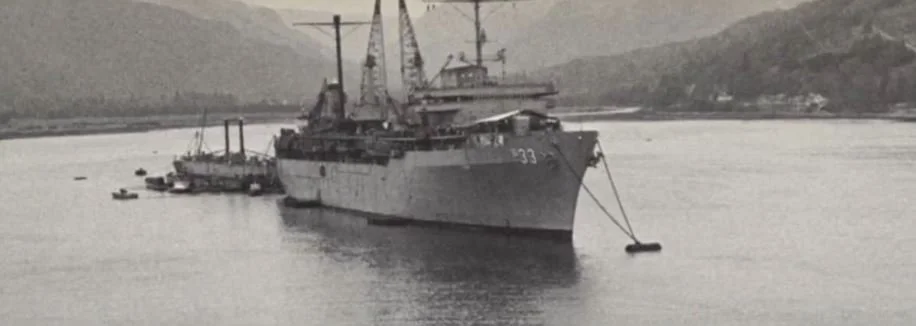
After two years ashore, Hollender received orders to the USS Simon Lake, a fleet ballistic missile submarine tender. From dry dock in Bremerton to the Panama Canal and Charleston, the Simon Lake was a floating city of repair, logistics, and Cold War readiness.
The ship could, in theory, build a nuclear submarine from scratch. “We had the parts, the shops, the welders. We could do it all—except we weren’t supposed to.” He recalls drills, Soviet trawlers, and even a catfish invasion that clogged the desalination system. “They served catfish for dinner that night. They swore it was pre-planned. None of us believed it.”
As the ship’s programmer, Hollender worked with XD Division—an elite team that kept the Navy’s early logistics systems running. He remembers shipmates like Chief Groff, Mr. Vech, Ron Papalone, Charlie Whitler, Carl Bess, and “Spaz,” the fearless hardware tech who routinely got shocked by charged capacitors. “He’d get knocked across the room, shake it off, and go right back to work.”
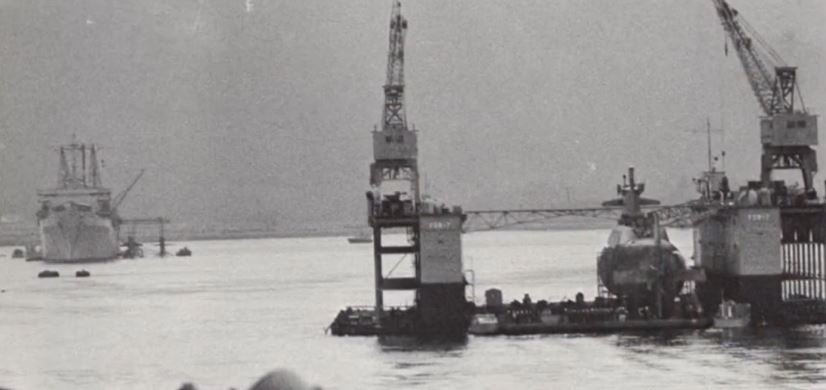
Despite the long hours, morale was high. “It was one great ship. People who served on her sister ship said the Simon Lake was built better, and it showed.” Hollender also recalled moments of tension and respect—like the time a young Marine bumped him in a passageway. “I looked at his shoulder, then at my crow, and said, ‘Private, we show courtesy on this ship. Do you understand?’ He did an about-face and walked away.” He reflected on his service and said, We were all part of something bigger.”
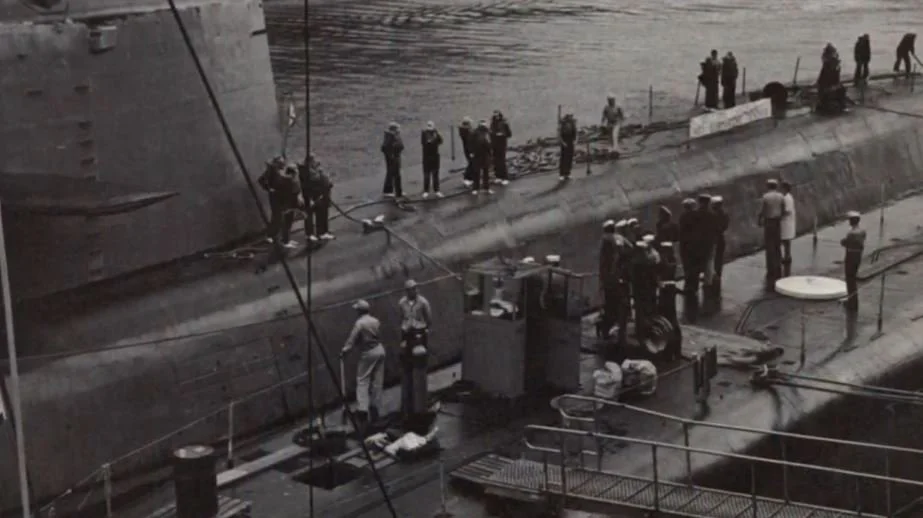
That “something bigger” was the Cold War nuclear deterrent. “We kept those subs working. We kept those sailors fed. We gave them what they needed to do their jobs.” Hollender’s sense of duty was inherited. His father, Henry Richard Hollender, served as a radioman aboard the USS Crockett in World War II. He rarely spoke of his service, but shared two stories: one about the joy of liberty in pre-Castro Havana, and another—a warning. “He told me he once disobeyed orders and went topside during general quarters. A piece of a Japanese plane, just shot down, flew past his head. He slammed the hatch shut and said he followed orders from then on.”
Later, Hollender discovered his father had been injured in that attack and hospitalized in the Philippines. “He didn’t get a Purple Heart—probably because he wasn’t supposed to be topside. Maybe that’s what he was trying to tell me: follow orders. There’s a reason for them.” After the war, Henry Hollender used the GI Bill to earn a master’s degree in social work and rose to become Chief of the Bureau of Children’s Services in New Jersey. “He was proud of his Navy time,” Hollender said. “He was part of the Greatest Generation. I just wish he had left more stories behind.”
DP2 Virgil Hollender’s story is not one of medals or headlines, but of steadfast service, humility, and humor. He served during a turbulent time, navigating the complexities of duty, technology, and Cold War tensions with grace. “I was never stationed on an aircraft carrier,” he said with a grin, “but my first and last time getting underway on a Navy ship was on one.” His story reminds us that service takes many forms. Some serve on the front lines. Others, like Hollender, keep the systems running, the data flowing, and the ships supported. They are the quiet patriots—those who defend the Constitution, do their job, answer the Nation’s call, and carry the legacy of service forward.
USNM Service Memories of DP2 Virgil Hollender
The United States Navy Memorial honors United States Navy Veteran, DP2 Virgil Hollender featured within this series titled, Tales from the Navy Log, Story of the Month. Each month, this series honors a Veteran’s story recorded by the Stories of Service Program at the Navy Memorial. To learn more about this story and to explore the Navy Memorial archive, visit the Navy Memorial Stories of Service site at https://www.navymemorial.org/stories-of-service